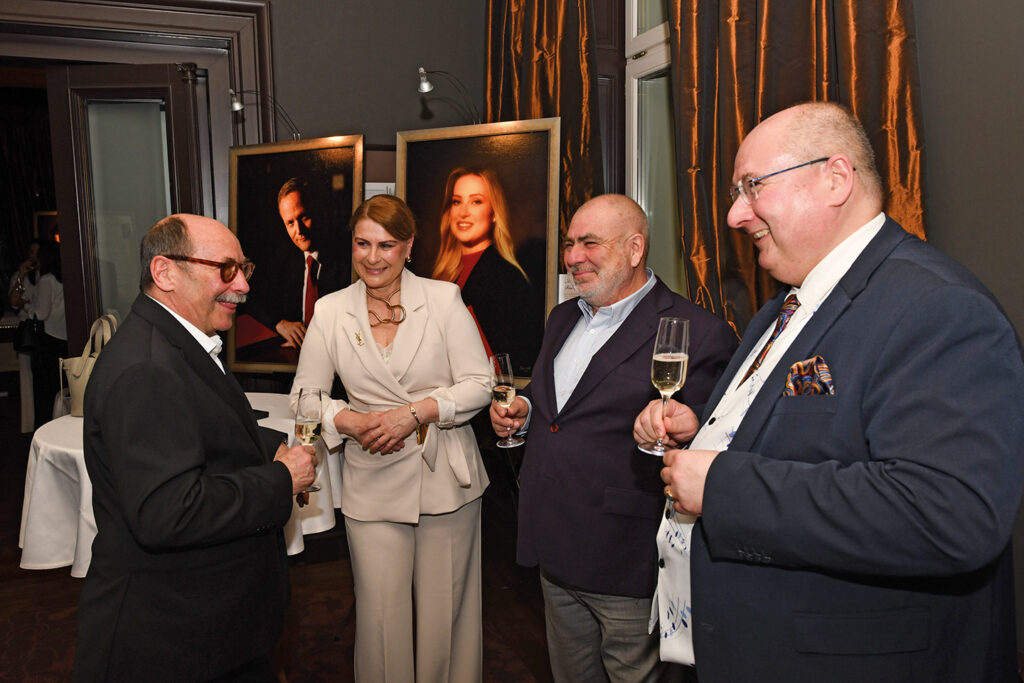
When I started looking into your background, I discovered that you are listed in the international aristocratic almanac of sovereign and noble houses. It states that you are a prince and a baron. It also mentions that you are the head of the House of Haugwitz of Biskupitz. Could you tell us more about this?
Yes, I am currently the head representative of the dynastic House of Haugwitz of Biskupitz. This is a lineage with documented ancestry dating back to the reign of Charlemagne. The history of our family spans over 1,200 years. I come from a branch of the family that held several Silesian principalities throughout history. Since then, we have held the hereditary title of sovereign dukes.
You are also the Grand Master of the Royal Order of Točenice. I’ve never heard of this order before, and I suspect most of our readers haven’t either. Could you tell us more about it?
The Royal Order of Točenice was founded by the Czech and Roman King Wenceslaus IV in Cheb on May 1, 1389. The symbol of the order was the “točenice” – a strip of fabric twisted into a spiral and shaped into a circle with a knot and loose ends. The Order’s chapel was subsequently established at Vyšehrad, and the order adopted the motto: Toho bzde toho (“So be it forever”). Thus began what was initially a rather informal chivalric brotherhood, likely inspired by England’s Order of the Garter, whose insignia was similarly awarded to distinguished individuals for merit. After King Wenceslaus IV’s death in 1419, the order continued to be passed down by Czech monarchs. The decline of the order came during the reign of Emperor Franz Joseph (1848–1916). This was due to the Czech national revival and the fact that the Emperor never accepted coronation as King of Bohemia, despite repeated promises between 1870 and 1871. As a result, the number of Točenice knights dropped sharply—older members died, and no new ones were inducted.The subsequent dissolution of the Bohemian Diet by the “St. Anne’s Patents” on July 26, 1913, and the weakening of the Royal Order of Točenice, who traditionally served as protectors of the Czech King’s land, paved the way for the illegitimate rise of the political system still in place today. This system declared a new Czechoslovak state and later a republic, but it never formally abolished the Kingdom of Bohemia. After 1918, descendants of the knights met irregularly and privately to keep the order’s traditions alive. In 2014, the descendants of the order’s original knights received patronage from a legitimate royal descendant—His Royal Highness Don Andrés Omar Ayala d’Valva, Prince of Pindus and Grand Duke of Macedonia, whose ancestry through the Bourbons includes Czech monarchs from the Habsburg, Jagiellonian, Luxembourg, and Přemyslid dynasties. This legitimate patronage provided the legal foundation for the restoration and renewal of the Order of Točenice (also known as Tusini) in the Czech Republic

And who, then, should be our king? Someone from the Habsburg family?
The Habsburgs’ legitimate claim to the Czech throne is undeniable. As a nation, we must face this fact with dignity and be prepared to address it responsibly. The unresolved property dispute with Liechtenstein is also a significant issue for our country—there is currently a lawsuit filed against the Czech state at the European Court. All of this stems from our politicians having ignored Liechtenstein for many years. As for the Habsburgs, the key question is how the current heir to the throne, His Imperial and Royal Highness Archduke Karl of Austria, would approach the matter—and also how to eliminate the negative perception of the Habsburg family that was deliberately cultivated in our country over the past hundred years. The average citizen carries a distorted and mostly negative view of the Habsburgs, instilled in school through the way Czech national revival was taught in literature and history classes.Who will be the Czech king will ultimately be decided by the monarchy itself—once this form of government returns to our lands.
You speak as though the monarchical form of government is bound to return to our country soon. Forgive me, but I see the transition from monarchies to republics as a certain form of societal progress. Or am I wrong?
Your feelings, madam editor, as well as those of much of the public, are understandable and based on logic—but they stem from the environment in which you grew up and from the mindset instilled by the current political system. If things were truly as you suggest, then a return to monarchy would be impossible anywhere and would indeed seem outdated. But the facts suggest otherwise. The reality is that there are still twelve constitutional monarchies in Europe today—something rarely mentioned in our public discourse. And modern history offers us a remarkable example: Spain. After decades as a republic, Spain successfully returned to monarchy. Today, it stands as one of Europe’s largest and most respected nations—and serves as an inspiration.Even Brussels, the seat of most European Union and NATO institutions, lies within the Kingdom of Belgium.
Do you truly believe that the Czech Republic could one day become a kingdom again? Doesn’t that seem like a utopian idea in today’s modern world?
You yourself, madam editor, as well as your readers, must surely sense the astonishing global changes that have unfolded with the return of President Donald Trump to the White House. A year ago, no one would have believed how profoundly the world would begin to shift because of his words and actions. The same can be said about the revolution in socialist Czechoslovakia in 1989. If, back in 1988, you had publicly stated that the Communist regime would fall within a year and that private property would be returned after fifty years, people would have called you crazy. Everyone living in the country at that time would have seen that as pure fantasy. And yet—it happened.
What, then, is the Order of the Točenice doing today? What are its goals and mission?
The Order is apolitical and awaits a legitimate Czech king. The knights of the Order protect peace, are committed to supporting and performing charitable deeds, and—if needed—are ready to defend the people of our land by all available means.We promote Christian culture, uphold Christian and noble traditions and customs, and preserve the historical legacy of our Order and of the Czech state. The knights of the Order strive to seek and safeguard truth, Christian faith, and love for one’s neighbor. They emphasize the need to awaken moral and spiritual values in every person—and thus, collectively, within society as a whole.

So you’re advocating a return to traditional values in society?
Yes, I advocate a return to our traditional values—those rooted in our geographic and cultural space—and to the original meaning and purpose of the rule of law. These include the values of traditional families, child-rearing, the benefits of entrepreneurship, and social security for our citizens. Young people should have access to housing and the ability to start families, especially considering that the original European population has been in decline for decades.
Yes, I’ve come across information about low birth rates in Europe. Do you have any concrete data on that?
From a historical standpoint, we know that no nation or its culture can sustain itself if the average birth rate falls below 2.11 children per family. When the rate drops to 1.9, population decline—and with it, cultural decline—slowly begins. In 2007, the average birth rate across the EU was 1.38 children per family. And today? It’s down to 1.1. To truly restore native European cultures, the number of children born to native populations would have to rise dramatically—but given the current economic situation of European states, this is unrealistic. Decline has been ongoing in Europe for more than 50 years, and now the pace is accelerating. One study highlighted a striking statistic: if two couples each have one child, and those two children then also have just one child together, the number of grandchildren ends up being just one-quarter of the number of grandparents. This means that within roughly 50 years, a population can shrink to a quarter of its original size. As the native population declines, so does its culture—and indigenous European nations are disappearing. We shouldn’t pretend it doesn’t affect us. Migration is not a reliable solution for boosting Europe’s population. It brings with it different mentalities, values, and customs—often incompatible with our mindset and cultural foundations. As for the Czech Republic, publicly available data is very clear. The current population stands at 10.86 million. Foreigners legally residing in the country make up 12–15%. In Prague, legal residents of foreign origin already account for 30% of the population. And then, of course, there are those living here illegally. I think that speaks for itself.
It’s said that you’re one of the most steadfast supporters of a monarchist form of government in the Czech Republic. How should we understand that?
That’s probably true. I can be quite persistent about certain things—and the Ministry of the Interior certainly knows this well. I am a monarchist by conviction, and that’s reinforced by the unsatisfactory state of our public administration. And I don’t mean only here in our country, but also across the rest of Europe, of which we are a part. Europe lacks strong security resilience, suffers from significant economic and defense deficits, and is lacking in overall efficiency. Western Europe, in particular, is in a moral, cultural, and societal crisis. The head of the Munich Security Conference recently stated that Western Europe is clearly in decline. Europe is weak now—it lacks resilience, and frankly, it won’t catch up even within ten years. Something really does need to change. We must pay far more attention to our national interests. Patriotism in the traditional sense—healthy national pride—must go hand in hand with balanced international relations and high-level diplomacy, which are clearly lacking today. When I look at how the Czech state and nation have declined over the past few years, I know that change is inevitable. The decay is visible in most ministries, across most government departments, and it extends throughout our entire society..
Where do you see the root cause of this decline? Which sector do you believe is in the worst shape? Where do you think change should begin?
We believed our politicians years ago when they told us that we live in a democracy, that we have freedom, that we are a democratic and lawful state, and that we are a developed country. But in a truly developed country, lawmakers don’t sit every day just to keep changing laws. That kind of activity signals societal immaturity and state instability. A mature state changes its laws only when it’s truly necessary.
We believed our politicians years ago when they told us that we live in a democracy, that we have freedom, that we are a democratic and lawful state, and that we are a developed country. But in a truly developed country, lawmakers don’t sit every day just to keep changing laws. That kind of activity signals societal immaturity and state instability. A mature state changes its laws only when it’s truly necessary.
I see major problems in the judiciary. The judicial system must (and is formally supposed to) function as impartial and independent. However, there also needs to be an effective, legally grounded system of oversight of judicial activity—and this is where we’re seriously lacking. This deficiency has led us dangerously close to a kind of judicracy, where in 35 years we have failed to establish proper control mechanisms. As a result, the Constitutional Court often ends up compensating for the oversight of lower courts, even though this isn’t its primary function. It has, in many rulings and decisions, corrected or redirected decisions of general courts—including the Supreme Court and the Supreme Administrative Court. We must realize we are talking about people’s lives and the fate of businesses—often with unacceptable delays. This leads to the opposite of justice: what we call denegatio iustitiae, or denial of justice. The state of the Czech judiciary is alarming, though many people don’t realize it—until they themselves end up in court. And this is undoubtedly a key pillar of public administration. It reflects the condition of our society and our state.
To conclude, let me ask—do you believe that we will see a return of the monarchy in the Czech lands anytime soon? And in what ways would a monarchy and the office of a king be better than a republic and the office of a president?
There is no real reason why a monarchy should be rejected in our country. Let’s reflect on the concepts of democracy and freedom. The key point isn’t the form of government (whether monarchy or republic), but rather the type of governance—either democratic (e.g., presidential, parliamentary, or monarchic systems) or undemocratic (e.g., authoritarian or totalitarian regimes). Our constitution guarantees every citizen the freedom of political opinion. So it’s surprising that a monarchist form of government with democratic principles is deemed unacceptable by certain state institutions.
I’ve received information that monarchists are reportedly listed by the Ministry of the Interior as extremists. If that’s true, it would mean that I—being a leading figure advocating for a monarchist system—could be systematically monitored or harassed by the current regime. So who’s violating the constitution—me, or some state authorities? Honestly, it’s hard to believe that something like this is even possible in a member state of the European Union.
I personally prefer a monarch to a president. The issue with a republic is that practically anyone can become president—even someone who has never been properly prepared for the role. A president’s term is also limited. In a monarchy, this isn’t the case. A king is raised for his role from childhood. He is taught to rule for his people, and his position is for life. It is his country and his nation. He approaches his duty like a steward—someone who would never allow the land to be plundered.
We can only have a kingdom again in our homeland if we, as a society and a nation, return to traditional values, basic decency, and a sense of responsibility—qualities that are sorely lacking in today’s society. The current system is ineffective and too often riddled with cronyism. It needs to be replaced by one that is stable and time-tested. I believe things will change with the return of a king—someone who, as a true guardian, will care deeply for the well-being of his people and the stability of the nation.
Author: Lenka Prokšová
Photo: archive of Mgr. Svatopluk Hugwitz